Wrong question. “Uncertainty is the only certainty there is” really hits home with the stock market, you can never be quite sure what is around the corner. Rather than becoming anxious about the uncertainty, better questions to ask yourself would be “Am I prepared to handle 2022?” and “What can I do to proactively anticipate these uncertainties?”
First question, do you know what is happening in the broader market right now?
Don’t forget that stock prices are affected by industry factors and macro factors 70% of the time!
Anticipate and keep abreast of the following factors can help you prepare for 2022.
- Impact of Covid-19 mutations on the market

The emergence of various covid-19 mutations has caused market volatility due to the uncertainties it brought along. Being proactive by monitoring important covid-19 figures can help you be prepared for it. Global daily new cases, global daily deaths, and daily new cases & deaths of important countries like US, UK, Germany, France are examples of some important stats to monitor.
If new variant emerges, anticipate some volatility and protect your open positions (make sure you have a stop loss, take profit if near all time high, or hedge against it with Options).
- Supply chain constraints – expected to last until Q2-Q3 of 2022

According to S&P Global, the supply chain disruptions are the largest stumbling block for the US economy. They expect price pressure to last well into 2022, and inflation will not reach the Fed’s target of 2% until late 2023.
For inflation to start decreasing, the main issue that needs to be resolved is the mismatch in supply and demand. Once that eases, the Fed no longer has to be so aggressive in increasing interest rate and the market can go back to normal with decreased volatility.
Once inflation reaches the target and the Fed doesn’t interfere so much in the market, the economy will see better growth. 2022 would most likely be more sensitive to inflation data and it would be crucial for us to monitor this. Other than the inflation rate, you may also monitor the US Purchaser Price Index (PPI) as it is a leading indicator for inflation. When it goes down, that’s when you know that the inflation pressure is easing.
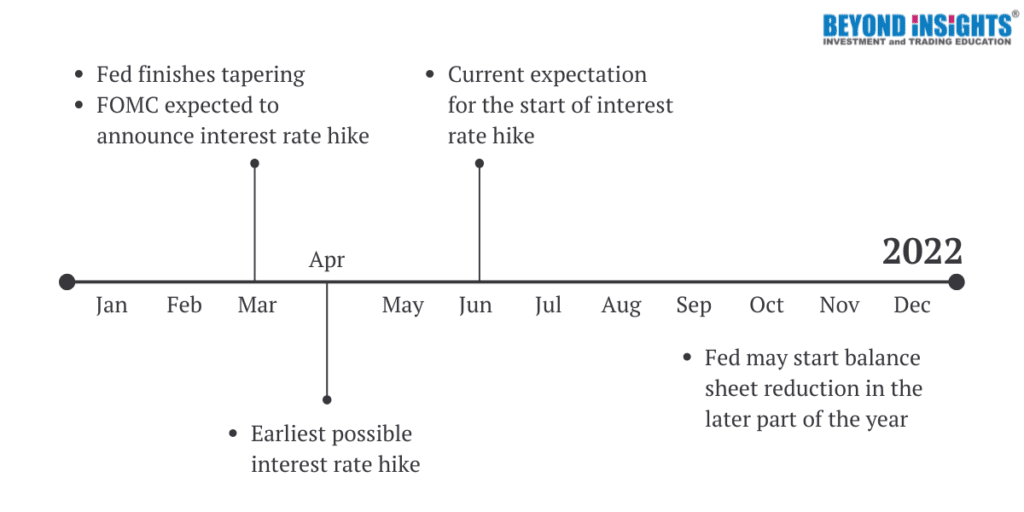
- The Fed’s Triple Threat: Tapering, Interest Rate Hike, Reduction of Balance Sheet

Tapering, reduction of balance sheet, and interest rate hike are forms of Quantitative Tightening process by the Federal Reserve to withdraw support for the US economy, so that it could go back to pre-pandemic level condition.
Tapering and reduction of balance sheet aims to reduce the overall money supply in the market, while interest rate hikes are used to slow inflation.
2022 will be the path back to normalization
According to Fed Chair, Jerome Powell on 11th January 2022, the economy no longer needs the accommodative policies that have been in place since the pandemic.
Therefore, he thinks the Fed will:
- End asset purchases in March
- Raise rates over the course of the year
- Allow the balance sheet to run off later in the year.
Pay attention to the 15th and 16th March 2022 FOMC statement and Q&A where further guidance may be provided.
Current expectations: