
By the Beyond Insights Editorial Team · Last reviewed: 6 November 2026 · 10 minute read
TL;DR: The best stock market education for a beginner is not the course with the boldest promises. It is the one that teaches a complete system, puts risk management and psychology before profit, lets you practise with real feedback, and stays with you after the course ends. Use the 7-point checklist below to judge any programme, including ours.
Key Takeaways
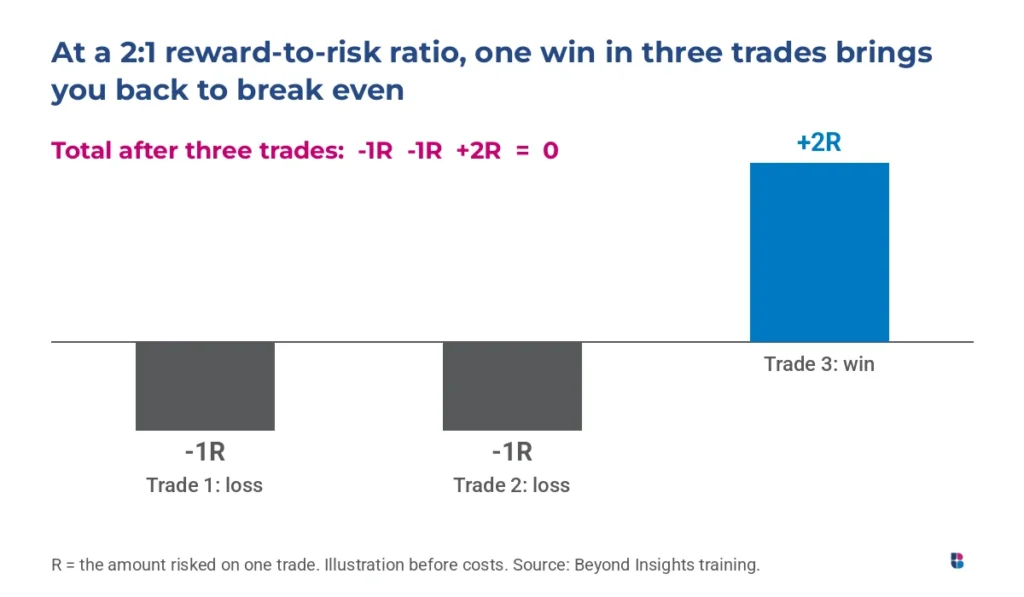
- Protecting your money is the first lesson, not the last. With a 2:1 reward-to-risk ratio, you can be right on only 1 trade in 3 and still break even before costs, which is why good courses teach risk before returns.
- Fake “investment education” is one of the costliest traps in Malaysia. Police recorded more than RM1.37 billion lost to non-existent investment schemes across 9,296 cases from January to November 2025 (PDRM via Free Malaysia Today, 2026).
- Learning to invest is not a promise to beat EPF. EPF paid 6.15% for 2025 (EPF, 2026). Good education helps you make careful decisions with the savings you manage yourself; it does not guarantee a higher return.
Part 1: What does stock market education for beginners actually mean?
Stock market education for beginners is structured learning that takes you from zero to making your own decisions: how shares work, how to choose them, when to buy and sell, how much to risk, and how to manage your emotions while real money is on the line. It is different from stock tips, which tell you what to buy without teaching you why.
What should a beginner learn first?
A beginner should learn how to protect capital before learning how to grow it. That means understanding position size (how much of your money goes into one stock), stop-loss levels (the price at which you accept you were wrong and exit), and why a small loss taken early is better than a large loss taken late. Choosing companies and reading charts come next, followed by timing and, much later, more advanced instruments.
Warren Buffett said it plainly in a 1994 interview: “Risk comes from not knowing what you’re doing” (Quote Investigator, 2018). A good course reduces that risk by replacing guesswork with a process you can repeat.
Part 2: Signal versus noise: where free content helps and where it stops
Is free YouTube and TikTok content enough to learn investing?
Free content is a fine starting point, but on its own it rarely adds up to a system. A video on one chart pattern, a reel on one “undervalued” stock and a thread on dividends are pieces of different puzzles. Beginners end up with many opinions and no method, and nobody checks whether they are applying any of it correctly.
Which free resources can Malaysians trust?
Start with the official ones. Bursa Malaysia runs Bursa Academy, a free e-learning platform for retail investors covering the securities, derivatives and Islamic capital markets (Bursa Malaysia, 2020). The Securities Commission Malaysia runs InvestSmart, its investor education programme, and keeps an Investor Alert List of unauthorised companies, websites and individuals.
These resources are neutral, accurate and free. What they cannot give you is a personal coach, live practice or feedback on your own decisions.
The bottom line: use free official resources to learn the language of the market, and pay for education only when it adds structure, practice and support you cannot get alone.
Part 3: What this means for Malaysians in 2026
Why does choosing the right course matter so much in Malaysia right now?
Because fake investment schemes are where Malaysians lose the most money to online fraud. From January to November 2025, the Royal Malaysia Police recorded 9,296 cases of non-existent investment schemes with losses of more than RM1.37 billion, the highest of any online scam category (PDRM, 2025). That works out to roughly RM147,000 lost per case.
The regulator is working hard to keep up. The Securities Commission added 273 names to its Investor Alert List in 2024 and another 59 in the first quarter of 2025 (SC, 2025).
The bottom line: the first skill a beginner needs is the ability to tell real education from a sales pitch for a scheme.
Is learning to invest worth it when EPF already paid 6.15%?
It can be, but not because a course guarantees you will beat EPF. Here is the honest arithmetic on RM10,000 held for one year.
EPF’s 6.15% dividend for 2025 would add RM615 (EPF via RTM, 2026). With Bank Negara’s Overnight Policy Rate at 2.75% (BNM, November 2026), a fixed deposit paying around 2.5% would add about RM250. Meanwhile, inflation of 1.8% (DOSM via Bernama, September 2026) quietly reduces what that RM10,000 can buy by about RM180.
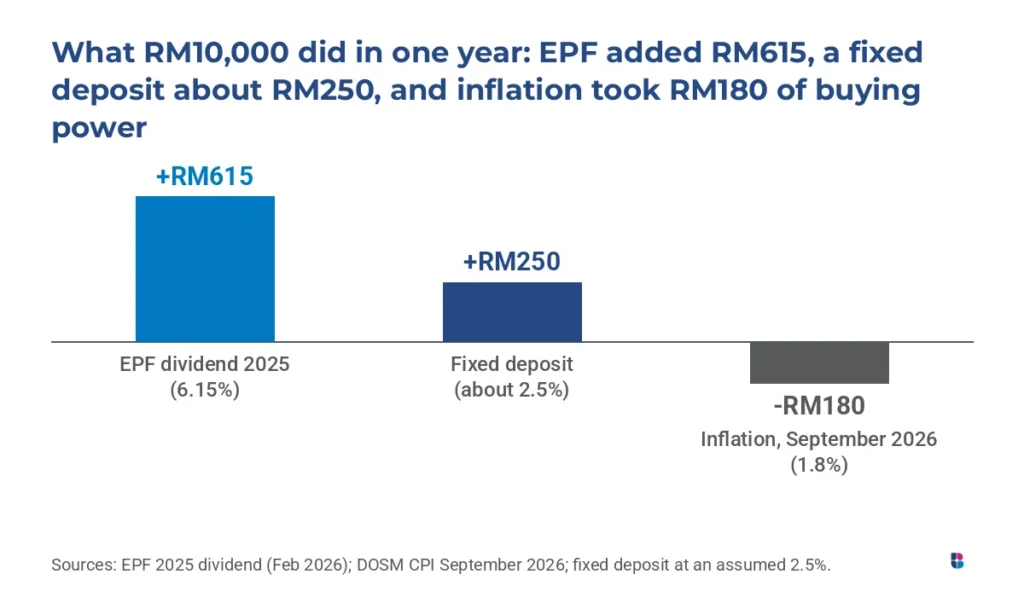
Many investors, including experienced ones, do not beat EPF’s return in a given year, and shares come with far more ups and downs along the way. So the real case for education is different. EPF is a retirement fund with withdrawal rules, not money you manage day to day. Education is for the savings you choose to invest yourself, so that you decide with a plan instead of a hunch, size your risk so that one mistake cannot wipe you out, and avoid the far larger losses that come from schemes and impulsive trades.
The bottom line: judge a course by whether it makes you a more careful decision maker, not by any return it promises.
Part 4: How do you choose the best stock market course? A 7-point checklist
1. Does it teach a complete system, in order?
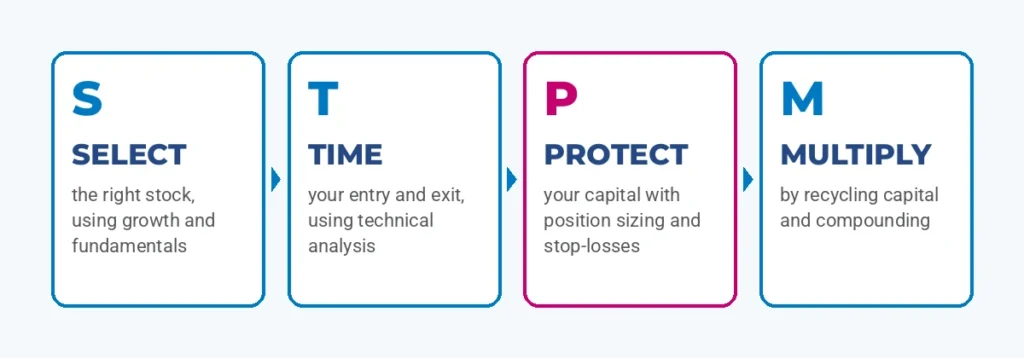
Look for a programme that connects every step: choosing what to buy, deciding when, sizing the position and growing the account over time. At Beyond Insights, that sequence is the STPM framework:
- Select the right stock, using growth and company fundamentals.
- Time your entry and exit, using technical analysis.
- Protect your capital through position sizing, stop-losses and money management.
- Multiply by recycling capital and compounding, with leverage instruments only where appropriate and later in the journey.
2. Does it teach risk before returns?
A serious course tells you how much you could lose before it talks about how much you could make. A rule taught at Beyond Insights is to risk no more than 1% of your capital on any single trade, and no more than 5% of the portfolio at any one time.
The maths shows why this matters. If each winning trade earns twice what each losing trade costs (a 2:1 reward-to-risk ratio), you need to be right only about one time in three to break even before costs. A beginner does not need to be right most of the time; a beginner needs losses that stay small.
3. Does it train psychology, not just mechanics?
Most beginners know they should cut losses. Far fewer do it when the moment comes. Benjamin Graham warned that an investor’s worst enemy “is likely to be himself” (The Intelligent Investor, 1949). Our founder, Kathlyn Toh, teaches that consistent success is 90% psychology and money management and 10% mechanics, which is why Beyond Insights has run trading psychology bootcamps since 2009. Ask any provider where in the course they train discipline and emotional control.
4. Do you practise, with real feedback?
Watching someone else trade is not the same as making decisions yourself. Good programmes give you exercises, case studies on real charts and a coach who reviews your reasoning. Ask how often you will practise and who will check your work.
5. Do the trainers invest and trade themselves?
Ask who teaches the course and whether they manage their own money in the market. Coaches who do understand losing streaks, nerves and patience from the inside.
6. Is there support after the course ends?
Much of the real learning happens in the months after a course, when the market does something unexpected. Look for refresher sessions, a student community and coaches you can still reach. A one-off weekend with no follow-up leaves you alone at the hardest point.
7. Are the claims honest and the boundaries clean?
The best providers make no return promises, never ask to hold or manage your money, and never tell you what to buy. Beyond Insights teaches you to make your own decisions. We do not manage client funds or give buy or sell calls.
Structured education versus hype-led courses
Swipe to see all columns →
| What to check | Structured education | Hype-led course |
|---|---|---|
| The promise | Skills and a repeatable process | Fast or guaranteed returns |
| Risk | Taught first, with clear rules | Mentioned briefly, if at all |
| Psychology | Trained deliberately | Replaced with motivation |
| Practice | Hands-on, with coach feedback | Watch-and-learn videos |
| Decisions | You learn to make your own | You copy calls from a group |
| Your money | Stays in your own brokerage account | You may be asked to transfer it |
| After the course | Ongoing support and community | Upsell or silence |
Source: Beyond Insights Editorial Team, drawing on Securities Commission Malaysia and Royal Malaysia Police scam guidance.
What are the red flags in a stock market course?
Walk away if you see guaranteed or fixed monthly returns, requests to transfer money to the provider or a personal account, pressure to pay today, “copy our trades” groups, or promises that you can quit your job to day trade within months.
That last one deserves care. Short-term trading is a demanding skill that is unforgiving to anyone without a system and firm risk rules. It is built in stages, on top of a solid foundation in investing and risk management, not learned in a few weekends as a quick way out of a salaried job.
Before you pay anyone who offers to manage your money or advise you on specific investments, check the SC’s licensed list and Investor Alert List. The SC’s own advice is never to transfer money unless it goes to a verified account of a licensed company (SC, 2025).
Where does Beyond Insights fit?
Beyond Insights has taught stock market investing and trading since 2008 and has trained more than 8,500 students, from business owners and doctors to retirees and university students. About 80% of our students begin with the Versatile Traders Package (VTP), which combines growth investing (GIX) with trend and swing trading (TST). We built our programmes around the checklist above, and we encourage you to hold us to it.
If you would like to see how the STPM framework works before committing to anything, join our free Global Investing and Trading Made Simple (GITMS) webinar. You can ask questions, see the approach in action and decide in your own time.
If you found this useful, share it with a friend who is thinking about starting to invest.
Frequently Asked Questions
What is the best stock market education for beginners in Malaysia?
The best option is a structured programme that teaches a complete system, puts risk management and psychology first, includes live practice with coach feedback and supports you after the course. It should make no return promises and never handle your money. Use free resources such as Bursa Academy and InvestSmart for the basics, then compare paid programmes against those criteria.
Can I learn stock investing on my own for free?
Yes, you can learn the basics for free through Bursa Academy, the SC’s InvestSmart programme, books and reputable videos. The challenge is turning scattered lessons into one consistent method and applying it under pressure. Many self-taught investors pay for gaps in their knowledge through losses. A structured course is worth considering once you plan to invest real money regularly.
How much money do I need to start investing in shares in Malaysia?
There is no single right amount. What matters more is where the money comes from. Invest only savings you will not need for emergencies or for several years, and keep your emergency fund separate. Starting small while you learn lets you practise risk rules, such as risking no more than 1% of your capital per trade, without serious damage.
How long does it take to learn stock trading as a beginner?
The concepts can be learned in weeks, but becoming consistent usually takes months of practice and review. The slowest part is rarely the analysis. It is building the discipline to follow your own rules whether you are winning or losing. Be cautious of any course that promises full-time trading results within a short period.
Is a stock market course worth the money?
A course is worth it if it changes how you make decisions: you follow a plan, size your risk, and avoid scams and impulsive trades. It is not worth it if what it sells is a promised return. EPF paid 6.15% for 2025, so judge education by better decisions and protected capital, not by a target return.
How can I tell if an investment course is a scam?
Warning signs include guaranteed or fixed returns, requests to transfer money to the provider, pressure to pay immediately, “copy our trades” groups and claims that you can quit your job quickly. Check the Securities Commission’s Investor Alert List, and confirm that anyone offering to manage money or give specific advice is licensed. Real education teaches you to decide for yourself.
Should beginners start with long-term investing or trading?
Most beginners do well with a foundation in both: how to choose quality growth companies, and how to time entries and exits with clear risk rules. Long-term investing builds patience, while swing trading over days to weeks builds discipline. Faster styles such as day trading and options belong later, once that foundation is solid.
Do I need a finance background to learn investing?
No. Beyond Insights students include business owners, accountants, doctors, retirees, homemakers and students. What matters more than background is a willingness to follow rules consistently and to accept that losses are part of the process. A good beginner course explains every term in plain language and builds up from the basics.
Sources
Malaysian official data – Employees Provident Fund, 2025 dividend announcement, 28 February 2026, reported by RTM: https://berita.rtm.gov.my/?p=526237 – Department of Statistics Malaysia, Consumer Price Index September 2026, reported by Bernama: https://www.bernama.com/tv/news.php?id=2622347 – Bank Negara Malaysia, Monetary Policy Statement, 5 November 2026, reported by The Star: https://www.thestar.com.my/business/business-news/2026/11/05/bank-negara-keeps-opr-steady-at-275
Regulators and enforcement – Royal Malaysia Police, Commercial Crime Investigation Department, online scam statistics January to November 2025, reported by Bernama and Free Malaysia Today: https://bernama.com/misc/rss/news.php?id=2500014 and https://www.freemalaysiatoday.com/category/nation/2026/01/04/over-rm1-3bil-lost-through-fake-investment-schemes-in-2025-say-cops – Securities Commission Malaysia, Chairman’s speech at Bersama InvestSmart Pahang, 20 June 2025: https://www.sc.com.my/resources/speeches/speech-at-bersama-investsmart-pahang-2025 – Securities Commission Malaysia, Investor Alert List: https://www.sc.com.my/investor-empowerment/investor-alert-list
Free education resources – Bursa Malaysia, Bursa Academy: https://bursaacademy.bursamarketplace.com/en/home – Securities Commission Malaysia, InvestSmart: https://investsmartsc.my/
Research and books – Graham, B. (1949), The Intelligent Investor, Harper and Row – Quote Investigator (2018), Risk Comes from Not Knowing What You’re Doing: https://quoteinvestigator.com/2018/03/18/risk/
About Beyond Insights
Beyond Insights is a Malaysian financial markets education company founded in 2008 by Kathlyn Toh. It has trained more than 8,500 students and is Asia’s pioneer in investing and trading psychology bootcamps, guided by its mission of bringing out the best in you and your financial future. This article was written by the Beyond Insights Editorial Team, drawing on company training materials, original research, and the insights of our founder.
Featured Expert: Kathlyn Toh
Kathlyn Toh is the founder, director and chief trainer of Beyond Insights. She began investing on the Kuala Lumpur Stock Exchange in 1993, trading US markets in 1997 and options in 2005. Before teaching full time, she led global teams at Intel. She is a certified Master NLP Practitioner and launched Beyond Insights’ first trading psychology bootcamp in 2009.
Risk Disclaimer
This article is for educational purposes only. It is not financial advice or a recommendation to buy, sell or hold any security. Investing and trading involve risk, including the loss of capital, and past performance does not guarantee future results. Beyond Insights does not manage client funds.
Join now!
GLOBAL INVESTING & TRADING MADE SIMPLE
A seminar that will transform the way you invest or trade in the stock market.