
By the Beyond Insights Editorial Team · Last reviewed: 12 November 2026 · 7 minute read
This is a developing story. Facts are correct as of Thursday, 12 November 2026 (Malaysia time). No decision on Jensen Huang’s role had been announced at the time of writing.
TL;DR: The Jensen Huang scandal has turned Nvidia’s biggest risk this week into a question of leadership, governance and US-China security concerns, rather than competition. Early market moves suggest investors are weighing which companies win a bigger share of AI spending, while still expecting that spending to continue. For investors, it is a lesson in reading Macro, Industry and Company together, and in putting risk management first.
Key Takeaways
A leadership shock can hit a share price even when the business is strong. Nvidia fell more than 8% in after-hours trading on 11 November (US time) on reports that its board was weighing Jensen Huang’s future (CNN, 2026).
The market moved money, not just away from AI. In the same session, AMD rose about 4% and Broadcom about 3%, which points to investors repricing market share rather than AI demand (Bloomberg, 2026).
The next clear checkpoint is 17 November. Nvidia reports its third-quarter results that day at 5 p.m. US Eastern Time, which is 6 a.m. on Wednesday, 18 November in Malaysia (NVIDIA, 2026).
What has happened at Nvidia?
Two separate controversies now surround Jensen Huang, the man who co-founded Nvidia in 1993 and has led it ever since.
What is the national security concern?
The first concerns a possible foreign intelligence effort. In late October, The New York Times reported that US intelligence officials believed an executive at a Singapore-based Nvidia customer had been recruited by Chinese intelligence and had grown close to Huang (Al Jazeera, 2026). On 8 November, Huang admitted to staff that he had been unfaithful to his wife, linking it to “the national security concerns raised in news reports” (TechCrunch, 2026).
The espionage allegation itself remains unproven. In a public statement, Nvidia’s board said it had no reason to believe national security or company secrets had been compromised, and opened an independent investigation led by a committee of independent directors with outside counsel (NVIDIA, 2026).
What is the governance concern?
The second is a question of how the company is run. On 11 November, The New York Times reported that Huang had a relationship with a senior Nvidia executive who reports directly to him. Nvidia, Huang and the executive have not confirmed the report.
This matters for a different reason. When a chief executive has a relationship with someone in their own reporting line, boards treat it as a governance issue, because it raises questions about fairness, conflicts of interest and oversight.
Has the board made a decision?
Not yet. Nvidia’s board met late on Wednesday, 11 November to consider whether Huang should remain chief executive, but no decision had been announced by the end of the night (Reuters, via The Next Web, 2026). Three days earlier, the same board had publicly expressed confidence in him.
What does this mean for investors?
Here is where it helps to slow down and separate the noise from what actually changes for the business.
Why could Nvidia face a double valuation threat?
Nvidia’s share price carries a premium because investors expect strong growth for years to come. Leadership uncertainty can shrink that premium even if quarterly earnings stay strong. That is the first threat.
The second is strategic. Huang has personally shaped Nvidia’s relationships with the hyperscalers (the giant cloud companies such as Amazon, Google and Microsoft that buy AI chips in huge volumes), with governments and with the wider build-out of AI data centres. Losing him could weaken that influence.
Nvidia’s CUDA software, the platform most AI developers already build on, is a strong competitive advantage that will not disappear quickly. But who leads the company next still matters.
Which companies could feel the effects?
The lists below are scenarios to study, not predictions and not recommendations. They show how one company’s crisis can ripple through an entire industry.
Companies that could gain if customers spread their orders:
- AMD could benefit if hyperscalers speed up plans to buy AI chips from more than one supplier.
- Broadcom (AVGO) builds custom AI chips for large customers. Demand could grow as companies reduce their reliance on Nvidia.
- Alphabet (GOOGL) and Amazon (AMZN) design their own AI chips (Google’s TPUs and Amazon’s Trainium). These in-house chips become more valuable as a backup.
- Huawei and Cambricon could see China’s push to replace US chips with local ones speed up if US restrictions tighten.
Companies that could face pressure if AI chip roll-outs slow:
- CoreWeave (CRWV), an AI cloud provider whose business is closely tied to Nvidia’s chips and support.
- TSMC, Micron and SK Hynix, which make or supply parts for AI chips. Near-term demand looks intact, but delays could shift the timing of orders.
- Networking, power and cooling suppliers for AI data centres, whose sales depend on how quickly new chips are installed.
Why should Malaysian and Singaporean investors pay attention?
This is the risk many people overlook. The intelligence allegations centre on a Singapore-based company, and the US is already concerned about AI chips reaching China through third countries.
If Washington tightens rules on chip exports or on overseas access to cloud computing, AI data centres in Singapore and Malaysia could face closer checks on who their customers are. That could affect the regional data centre build-out that has been a major growth story for both countries.
The bottom line: a scandal in California can become a policy question in Johor and Singapore.
What is the market telling us?
Following the leadership reports on 11 November, Nvidia fell about 8.6% in after-hours trading, while AMD rose about 4% and Broadcom about 3% (CNN, 2026; Bloomberg, 2026). Nvidia’s shares had already lost about 23% over the past month (Benzinga, 2026).
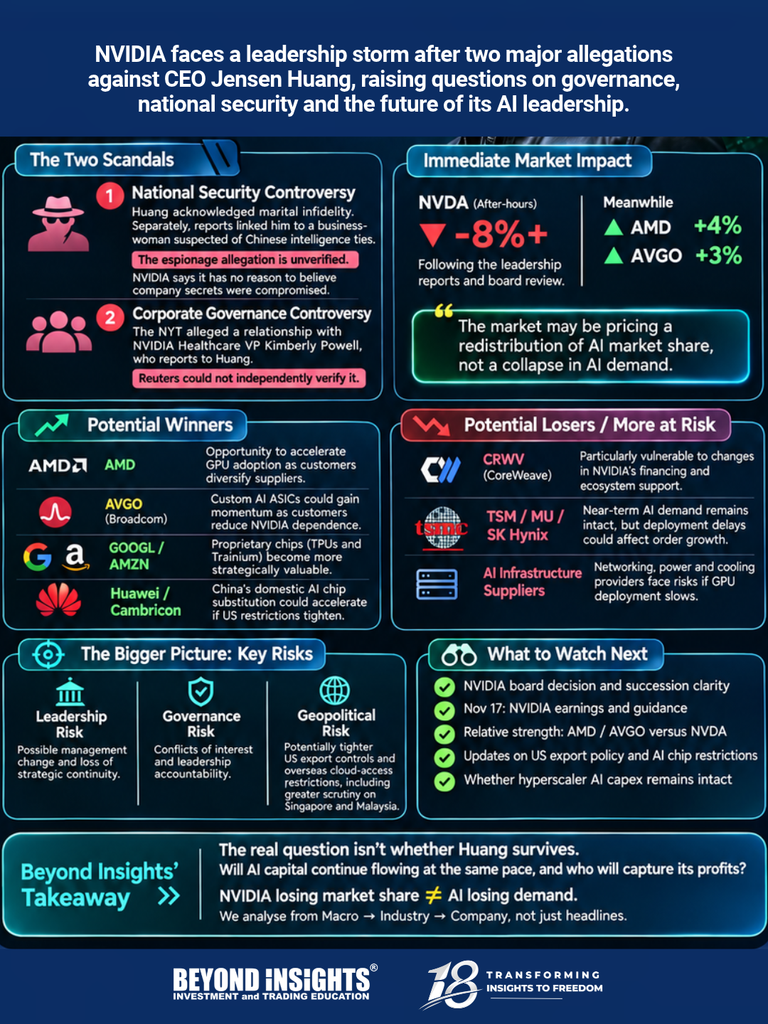
When one stock in a sector falls and its closest rivals rise on the same news, it usually means investors are moving money within the sector rather than leaving it. In plain terms, the market appears to be asking who will capture AI spending, not whether AI spending will continue.
One evening of after-hours trading is a first reaction, not a verdict. Prices can change quickly once the board announces its decision.
The bottom line: a falling leader is not the same as a falling industry.
What should you watch next?
Four developments will tell us much more than the headlines:
- The board’s decision and succession plan. A clear and credible successor would reduce uncertainty. Nvidia has not named one.
- Nvidia’s results and guidance on 17 November. Watch whether orders and next-quarter guidance stay strong despite the turmoil.
- How AMD and Broadcom trade compared with Nvidia. If the gap keeps widening over several weeks, it suggests the shift in market share is being taken seriously.
- Hyperscaler spending plans and US export policy. These decide how much money flows into AI chips, and where it is allowed to go.
How should investors respond?
Kathlyn Toh, founder of Beyond Insights, put the central question this way: “Nvidia losing market share does not mean AI is losing demand. The real question is whether AI capital keeps flowing, and who captures the profits.”
This is why we analyse from the top down, using the 40-30-30 approach: around 40% of a stock’s movement comes from macro factors (interest rates, policy, the economy), 30% from its industry and 30% from the company itself. A headline about one chief executive is a company-level event. The industry picture, AI demand, and the macro picture, US policy and global money flows, are separate questions. Looking at all three stops one headline from driving the whole decision.
From there, our STPM framework (Select, Time, Protect, Multiply) gives a clear order of priorities:
- Protect comes first. For anyone already holding Nvidia, leadership uncertainty is a reason to review position size and exit levels now, not after the news breaks. In our programmes, we teach students not to risk more than 1% of their capital on a single trade, or more than 5% of their portfolio at any one time.
- Time before acting. When news creates sharp swings, the daily trend often becomes unclear. Experienced short-term traders may look for opportunities inside that volatility, but only with a written plan, a defined stop-loss and a position size they can afford to get wrong. Others may simply wait for a clearer trend to form.
- Select with the full picture. Before choosing between Nvidia and its rivals, look at the industry and macro picture, not only this week’s news.
As Kathlyn often reminds students, the aim is to find the certainty within the uncertainty. Whatever you decide, always have a trading plan with risk management built in.
Join now!
GLOBAL INVESTING & TRADING MADE SIMPLE
A seminar that will transform the way you invest or trade in the stock market.
Frequently asked questions
Why did Nvidia shares fall in November 2026?
Nvidia shares fell after reports that its board was considering whether Jensen Huang should remain chief executive. This followed two controversies: reports linking him to a person US intelligence officials reportedly believed was working for China, and a New York Times report of a relationship with an executive who reports to him. Nvidia fell more than 8% in after-hours trading on 11 November.
Has Jensen Huang been removed as Nvidia’s CEO?
As of 12 November 2026, no decision had been announced. Nvidia’s board met late on 11 November to discuss his future, and has an independent investigation under way into the reported foreign intelligence effort. Check Nvidia’s official newsroom for the latest update, as this story is changing quickly.
Why did AMD and Broadcom shares rise when Nvidia fell?
Investors appear to expect that large customers may spread their AI chip orders across more suppliers if Nvidia’s leadership becomes uncertain. AMD is Nvidia’s closest rival in AI chips, and Broadcom designs custom AI chips for large cloud companies. Both rose in after-hours trading while Nvidia fell. One session of trading is an early reaction, not a confirmed trend.
Does this mean the AI boom is over?
Not on current evidence. The market’s early reaction suggests investors are repricing which companies capture AI spending, rather than expecting that spending to collapse. The bigger tests are Nvidia’s results on 17 November, cloud companies’ spending plans and US export policy. These say far more about AI demand than one company’s leadership questions.
How could this affect Malaysia and Singapore?
The intelligence allegations involve a Singapore-based company, and the US is already concerned about AI chips reaching China through third countries. If US export rules or limits on overseas cloud access tighten, AI data centres in Malaysia and Singapore could face closer compliance checks, which could affect the region’s data centre growth.
What should I do if I hold Nvidia shares?
Beyond Insights does not give buy, sell or hold advice. As an educational principle, uncertainty is a reason to review risk before anything else: check your position size, decide your exit level in advance, and make sure no single stock can do serious damage to your portfolio. A written trading plan helps you act on a process rather than on headlines.
Sources
Company statements
- NVIDIA, Statement From NVIDIA Board of Directors, 8 November 2026
- NVIDIA, NVIDIA Sets Conference Call for Third-Quarter Financial Results, 28 October 2026
News reporting
Benzinga via AOL, Nvidia Stock Sinks as Jensen Huang Ouster Report Sends Investors Toward AMD, Broadcom, 12 November 2026
CNN, Nvidia board weighs Jensen Huang’s future: live updates, 11 November 2026
Bloomberg, AMD, Broadcom, Alphabet Poised to Gain From Nvidia Scandal, 12 November 2026
The Next Web (citing Reuters), Jensen Huang’s fate hangs on Nvidia’s board after overnight meeting, 12 November 2026
TechCrunch, The unfolding Jensen Huang scandal: a timeline, 11 November 2026
Al Jazeera, Why is Nvidia’s Jensen Huang at the centre of a US-China spy scandal?, 9 November 2026
About Beyond Insights
Founded in 2008 by Kathlyn Toh, Beyond Insights is a Malaysian financial markets education company and Asia’s pioneer in Investing and Trading Psychology Bootcamps. We have trained more than 8,500 students to invest and trade with structure, discipline and confidence. This article was written by the Beyond Insights Editorial Team, drawing on company training materials, original research, and the insights of our founder.
Disclaimer: This article is for educational purposes only and is not a recommendation to buy or sell any security. Beyond Insights is not a licensed investment adviser, does not give buy or sell calls and does not manage client funds. Information reflects data available on 12 November 2026 and may change. Investing involves risk, including the loss of capital.